No fixed road network at sea
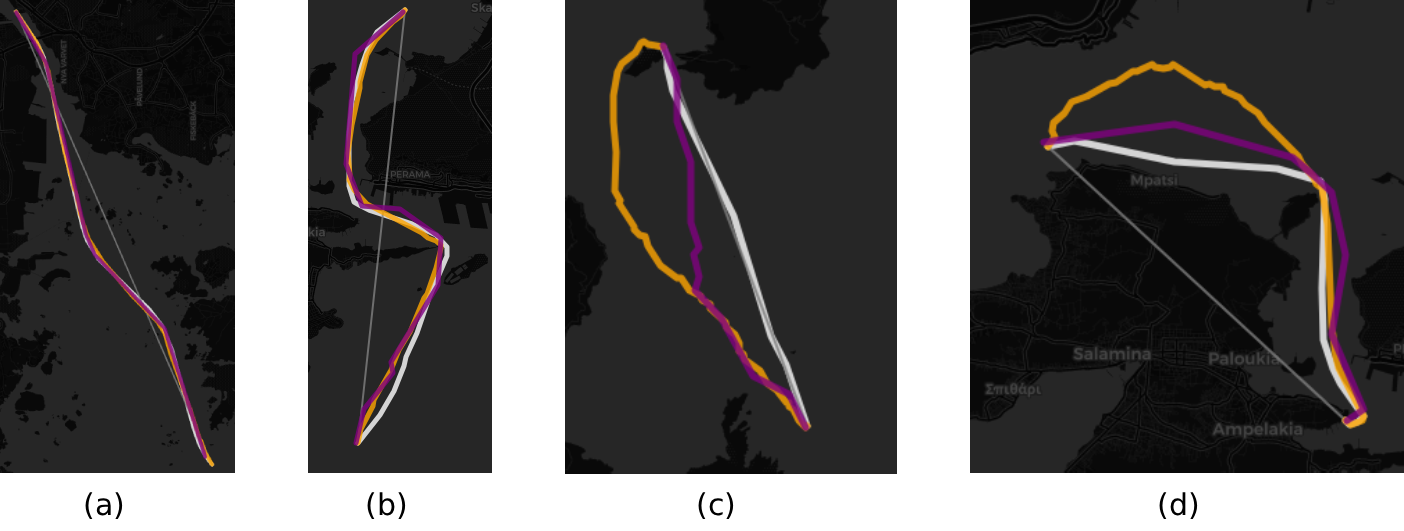
Unlike urban vehicles, vessels do not move on a stable road graph; routes can shift with traffic, weather, regulations, and geography.
HABIT: A Lightweight Imputation Framework for Vessel Trajectories
University of the Aegean · Archimedes/Athena RC · Hellenic Institute of Marine Technology · Athena RC · Hellenic Mediterranean University
Modeling vessel activity at sea is important for route planning, maritime logistics, safety, surveillance, and environmental monitoring. AIS data enables large-scale vessel tracking, but coverage limits, irregular reporting, and transmission interruptions often create long gaps in trajectories, reducing the quality of downstream mobility analysis.
This paper introduces HABIT, a lightweight and configurable H3 Aggregation-Based Imputation framework for vessel trajectories. HABIT learns movement patterns from historical AIS data, indexes transitions over H3 cells, infers likely missing paths with graph search, and reconstructs smoothed, navigable trajectories using data-driven coordinate projections.
Unlike urban vehicles, vessels do not move on a stable road graph; routes can shift with traffic, weather, regulations, and geography.
Vessels exhibit smooth turns, port maneuvering, anchorage behavior, and constraints related to vessel size and draught.
Imputed paths should avoid land, protected zones, and unrealistic abrupt turns while remaining faithful to historical AIS behavior.
Clean raw AIS positions, remove noisy records, detect stops and communication gaps, and segment each vessel track into trips.
Project locations to H3 cells, aggregate traffic statistics, and construct a weighted transition graph from historical movement.
Map gap endpoints to graph nodes and use A* search to recover likely cell sequences through frequent maritime routes.
Apply data-driven coordinate projection and RDP simplification to produce realistic, smooth, and navigable paths.
@inproceedings{spiliopoulos2026Habit,
  title     = {{Data-Driven Trajectory Imputation for Vessel Mobility Analysis}},
  author    = {Spiliopoulos, Giannis and Troupiotis-Kapeliaris, Alexandros and Patroumpas, Kostas and Liapis, Nikolaos and Skoutas, Dimitrios and Zissis, Dimitris and Bikakis, Nikos},
  booktitle = {Proceedings of the 29th International Conference on Extending Database Technology (EDBT)},
  address   = {Tampere, Finland},
  year      = {2026}
}