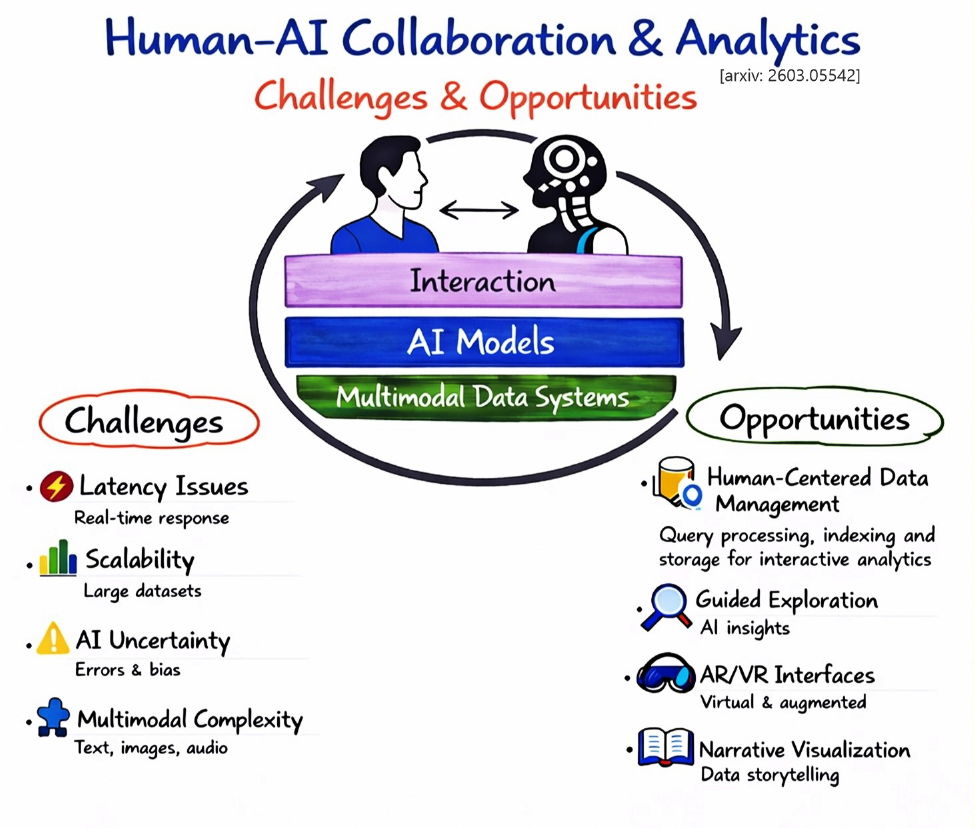
Tightly coupled requirements
Human-data interaction systems must integrate responsive interaction, multimodal data handling, guidance, visualization, and trustworthy AI feedback.
Challenges & Opportunities for Human-centered Systems
University Paris-Saclay & Inria · Northeastern University · Carnegie Mellon University & Apple · Ohio State University · New Jersey Inst. of Technology · Columbia University · Hellenic Mediterranean University & Archimedes/Athena RC · Athena RC · University of Pittsburgh · Tsinghua University · Xi'an Jiaotong-Liverpool University
The rapid advancement of AI is transforming human-centered systems, with major implications for human-AI interaction, human-data interaction, and visual analytics. Data analysis increasingly involves large-scale, heterogeneous, and multimodal data that is often unstructured, while foundation models such as LLMs and VLMs introduce new uncertainty into analytical workflows.
The paper examines how these changes expose persistent challenges in latency, scalability, interaction, exploration, reliability, and interpretability. It argues for end-to-end, human-centered systems that co-design data management, AI components, interfaces, and visualization, while keeping humans meaningfully involved through feedback, verification, and trust calibration.
Human-data interaction systems must integrate responsive interaction, multimodal data handling, guidance, visualization, and trustworthy AI feedback.
Multimodal data, complex interactions, embeddings, streams, and deep learning models all intensify scalability and responsiveness constraints.
System architecture, data operations, AI models, interfaces, and visualization need to be designed together, not optimized independently.
AI can support guidance, semantic understanding, and usability, but brittleness, errors, unpredictability, and bias make human-in-the-loop oversight indispensable.
Visualization is shifting from static depiction to progressive, narrative, aesthetics-aware, and adaptive guidance for sensemaking and trust.
The research agenda spans systems, databases, AI, information visualization, HCI, computer graphics, and cognitive science.
Interactive systems need real-time response to preserve analytical flow.
Query processing, indexing, and storage can be optimized for interactive analytics.
Large datasets and high-velocity analysis require scalable data operations.
AI suggestions can help users discover what can be asked and analyzed.
Errors and bias require verification, provenance, and human oversight.
Virtual and augmented environments can support in-the-world analytics.
Text, images, audio, video, and rich documents require new abstractions.
Data storytelling can guide attention and improve interpretation.
For further details on the discussed topics, readers are pointed to the following review papers and overview works. Click each topic tile to expand the corresponding publications.
Human-centered AI, interactive AI, data storytelling, and human-AI interaction.
Oxford University Press, 2022
International Journal of Human-Computer Studies, 2024
ACM CHI, 2024
ACM CHI, 2019
Systems, benchmarks, exploration, visualization-aware processing, scalability, and interactive analytics foundations.
arXiv:2511.15585, 2025
ACM SIGMOD Blog, January 2025
ACM SIGMOD Record, 2025
IEEE Transactions on Visualization and Computer Graphics, 2021
IEEE Transactions on Visualization and Computer Graphics, 2024
IEEE Transactions on Visualization and Computer Graphics, 2024
The VLDB Journal, 2020
CIDR, 2017
Encyclopedia of Big Data Technologies, Springer, 2022
BigVis workshop, 2020
ACM SIGMOD, 2018
ACM SIGMOD, 2020
ACM SIGMOD, 2020
Grand challenges, insight mining, design handoff, and human-centered visual analytics methods.
IEEE Computer Graphics and Applications, 2023
Visual Informatics, 2025
IEEE Transactions on Visualization and Computer Graphics, 2020
Visual Informatics, 2025
Generative AI, AI4VIS, ML4VIS, foundation models, evaluation benchmarks, and visual analytics for machine learning.
IEEE Transactions on Visualization and Computer Graphics, 2024
IEEE Transactions on Visualization and Computer Graphics, 2024
IEEE Transactions on Visualization and Computer Graphics, 2022
IEEE Transactions on Visualization and Computer Graphics, 2022
IEEE Computer Graphics and Applications, 2022
Visual Informatics, 2024
Computational Visual Media, 2024
IEEE Transactions on Visualization and Computer Graphics, 2025
Computational Visual Media, 2021
IEEE Transactions on Visualization and Computer Graphics, 2019
IEEE Transactions on Visualization and Computer Graphics, 2025
@misc{fekete2026humanDataInteractionAI,
  title  = {Human-Data Interaction, Exploration, and Visualization in the AI Era: Challenges and Opportunities},
  author = {Fekete, Jean-Daniel and Hu, Yifan and Moritz, Dominik and Nandi, Arnab and Basu Roy, Senjuti and Wu, Eugene and Bikakis, Nikos and Papastefanatos, George and Chrysanthis, Panos K. and Li, Guoliang and Yu, Lingyun},
  year   = {2026},
  eprint = {2603.05542},
  archivePrefix = {arXiv}
}